Roof Live Load
Roof Live Load
Roof Live Load: A load on a roof produced (1) during maintenance by workers, equipment, and materials, and (2) during the life of the structure by movable objects, such as planters or other similar small decorative appurtenances that are not occupancy related [1].
Partial Loading: The uniform live load applied only to a portion of a structure or member shall be accounted for if it produces a more unfavorable load effect than the uniform live load applied over the full structure or member. Uniform live loads applied to a portion of a structure or member are permitted to be reduced in accordance with Section 4.8 REDUCTION IN UNIFORM ROOF LIVE LOADS [1].
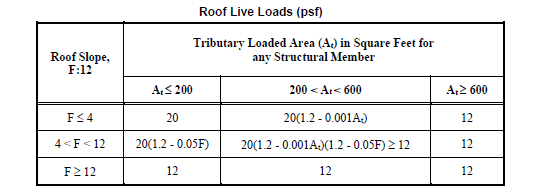
Partial Loading of Roofs: Where uniform roof live loads are reduced to less than 20 psf (0.96 kN/m2) in accordance with Section 4.8.2 of [1] and are applied to the design of structural members arranged so as to create continuity, the reduced roof live load shall be applied to adjacent spans or to alternate spans, whichever produces the greatest unfavorable load effect [1].
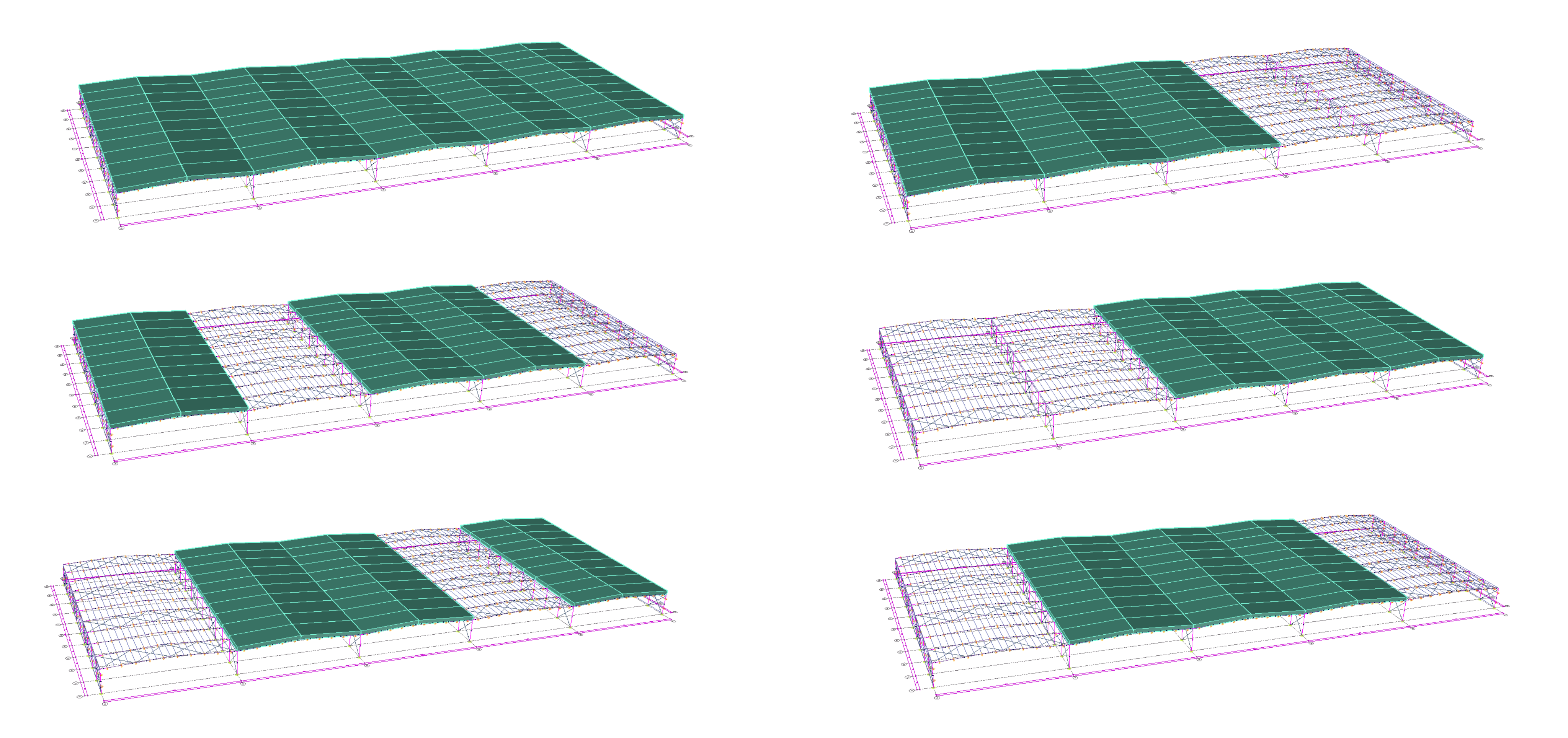
MkaPEB accounts for the above requirements when applying roof live loads for the design of both primary frame members and secondary members (Purlins). However, because the tributary (loaded) area of a purlin is typically less than 200 ft², the roof live load is applied without reduction. For the primary frames, the tributary area is typically greater than 200 ft²; therefore, the roof live load is reduced in accordance with the table shown above from [1], and is applied using the load patterns presented below, consistent with the MBMA manual [2].
References:
[1] American Society of Civil Engineers. "Minimum design loads and associated criteria for buildings and other structures." American Society of Civil Engineers, 2022.
[2] Metal Building Systems Manual, 2024 Edition.